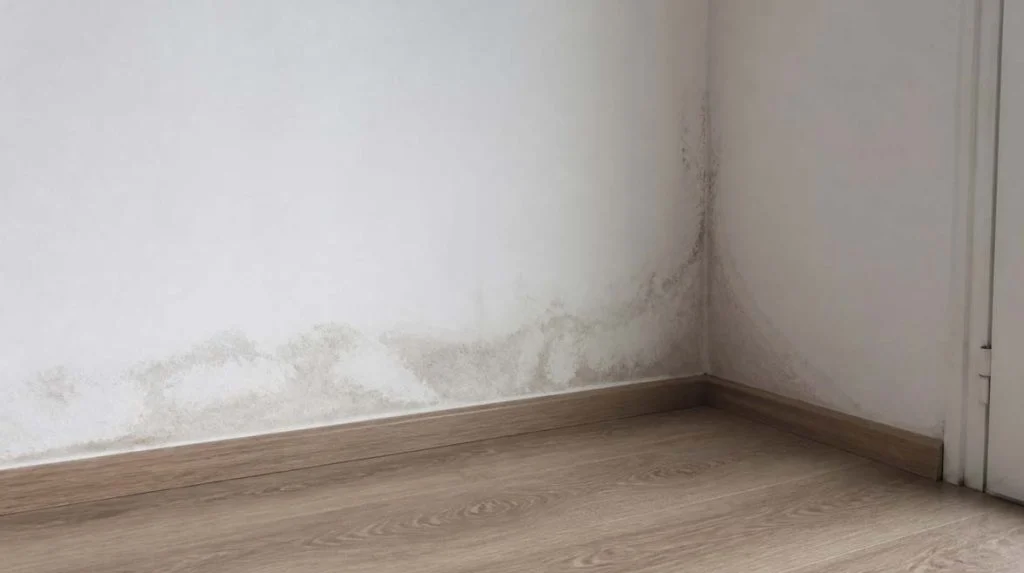
If we have just been handed the keys to a new-build home and, a few weeks later, a dark stain appears next to the skirting board, the paint bubbles in a corner of the bedroom or the bathroom smells musty, there is a construction problem that we should claim for. One of the most troublesome is, without doubt, damp on walls. It is both surprising and annoying, because nobody expects it to appear in a newly built property.
At DPcon we know that feeling well, as specialists in claims for damage to habitability in homes and buildings. People ask us whether it is normal for damp to appear on the walls of a new home and no, it is not normal. Nor will it go away on its own: you need to act with the help of professionals, but always after making a claim against the builder or the developer.
What is damp on walls and why is it construction damage?
We speak of damp on walls when water, as a liquid or as vapour, penetrates or builds up in the walls and partitions of a home. It shows itself as stains, efflorescence (a white powder of salts), flaking, bubbling paint, mould, a damp smell or a feeling of cold in the rooms.
A home has to be watertight and healthy. The Spanish Technical Building Code (CTE) devotes an entire basic document, DB HS 1 “Protection against damp”, to requiring that walls, façades, floors and roofs keep water out, and another, DB HS 3 “Indoor air quality”, to guaranteeing enough ventilation to prevent condensation.
When a new home has damp, it is because one of these requirements has not been met in the design or in the execution of the works. That is why, with few exceptions, damp in a recently built home is not a maintenance problem but claimable construction damage.
The Spanish Building Act (LOE) includes hygiene, health and environmental protection among the basic habitability requirements of a building (article 3.1.c). For that reason, in most cases the courts treat damp as a habitability defect, with a three-year guarantee period, as we will see below.
Types of damp on walls
What types of damp can appear on the walls of a home 🤔? We need to be able to identify it if we want not only to put the problem right, but also to make a claim should it come to that.
The key is to work out where the damp comes from and act accordingly (depending on that origin, we will be dealing with one type of construction fault or another):
| Type | How to recognise it | Where it usually appears | Usual fault in a new build |
|---|---|---|---|
| Condensation | Black spots of mould, droplets on window panes and cold walls, a musty smell. It gets worse in winter. | Corners, junctions with the ceiling, behind wardrobes, bathrooms, north-facing bedrooms. | Thermal bridges, insufficient or badly fitted insulation, ventilation that does not comply with DB HS 3. |
| Penetrating damp | Irregular stains that grow or darken when it rains; sometimes dripping. | Façades, junctions with windows, ceilings under a roof or terrace, below-ground walls. | Defective waterproofing, sealing of window and door frames, badly resolved roofs and terraces. |
| Rising damp | A horizontal stain on the lower part of the wall (up to about 1 m), salts, damaged skirting boards and paint. | Ground floors, basements, homes in contact with the ground. | A missing or badly executed damp-proof barrier, drainage or waterproofing of foundations and ground slabs. |
| Leaking installations | A localised, persistent stain that does not depend on the weather. | Next to bathrooms, kitchens, downpipes, radiators or underfloor heating. | Badly made joints in water, heating or drainage pipes. |
| Construction moisture | Slight, widespread damp during the first few months, which gradually fades. | The whole home, especially plaster partitions and floor slabs. | Water from the materials themselves (mortar, plaster, concrete) that has not yet evaporated. |
☑️ Condensation damp
This is the most common type in new homes. The water vapour we produce when cooking, showering or breathing condenses when it touches a cold surface. This kind of damp on walls always appears in the same places (corners, slab edges, around windows), so what we are normally looking at is a thermal bridge, that is, an area where the insulation is interrupted.
In an earlier article we explained in detail how to prevent condensation caused by thermal bridges.
☑️ Penetrating damp
Water comes in from outside through the façade, the roof, the terraces or the below-ground walls. Its hallmark is that it is linked to rain (the stain grows or darkens after a spell of rain). It is especially common in the garages and basements of new builds.
☑️ Rising damp
Water from the ground rises through the pores of the materials, just as it climbs up a sponge. It should not exist in a new build, because the CTE requires barriers and waterproofing in the elements in contact with the ground. If it appears, there is almost always a fault in the execution of the works.
At DPcon we are specialists in claims for rising damp. Find out more and contact our team if you are in a similar situation.
☑️ Damp caused by leaking installations
A badly connected pipe, a waste pipe with no fall or a poorly sealed shower tray can soak a partition for weeks before the stain becomes visible. It is a defect in the installations and it can also be claimed for.
☑️ Construction moisture
A newly finished building contains a considerable amount of water from mortar, plaster and concrete, which evaporates over the first few months. This residual damp on walls may encourage some condensation at first, but it should fade with normal ventilation. If it persists, gets worse or is concentrated in specific places, we are no longer talking about construction moisture but about a defect.
Why does damp appear on the walls of a newly built home?
When damp on walls appears a few days or weeks after handover, the most frequent causes we find in our expert reports are:
- A rushed handover, as the walls are painted and the partitions closed up without letting the plaster and mortar dry, and the moisture is trapped under the paint.
- Unresolved thermal bridges such as slab edges, columns in the façade, roller-shutter boxes or window surrounds without continuous insulation.
- Insufficient or badly fitted insulation (panels with gaps, poorly fixed or soaked during the works).
- Poor ventilation in the form of mechanical ventilation systems that do not work, are badly sized or lack enough air inlets, in breach of DB HS 3.
- Defective waterproofing of roofs, terraces, planters, basement walls or ground slabs.
- Badly sealed window and door frames (joints between the window and the façade left unsealed or without a proper sill).
- No damp-proof barrier on ground floors or in contact with the ground.
- Badly executed installations (leaks in water, heating, underfloor heating or drainage pipes).
- Materials that do not match the design or changes made on site to cut costs without technical justification.
Common examples of damp on walls in new builds
If the home is new, in what situations might damp appear on the walls that we could claim for? It may seem hard to believe when the property has only just been handed over, but unfortunately construction damage of this kind does make an appearance.
Over the last year, for example, at DPcon we have represented clients with claims for damp on walls in cases like these:
Ground-floor flat with a garden
Two months after handover, a band of damp and salts about 40 cm high appears on all the partitions facing the garden. The typical origin: insufficient waterproofing of the wall or of the ground slab in contact with the ground (rising damp).
North-facing bedroom
Black mould in the top corner and behind the wardrobe from the very first winter. The origin is usually a thermal bridge at the slab edge together with insufficient ventilation (condensation).
Top-floor flat under a roof or terrace
Stains on the ceiling and the upper part of the wall that grow every time it rains. It normally originates in badly resolved waterproofing of the roof or of the terrace above (penetrating damp).
Internal bathroom
Bubbling paint on the partition next to the shower. The origin is to be found in a badly sealed shower tray or a leak at the pipe connection (installations).
Around the windows
Stains at the corners of the windows after the first storms. The problem comes from the lack of sealing between the window frames and the façade.
Storage rooms and garages
Damp walls, standing water and a smell of mould. We have seen it in judgments such as the one on standing water and damp in storage rooms.
The usual response of the developer or builder to damp on walls
One of the most common responses from developers is that the damp “is normal in a new house” or that “it is the owners’ fault for not ventilating enough“. At DPcon we are not saying they are never partly right, but it should not simply be accepted. If we notice the signs listed here, they are clear indicators that there is a defect:
- The damp does not fade as the months go by, or it gets worse.
- It always appears in the same places (corners, skirting boards, around windows) and not across the whole home.
- It coincides with rain, or forms a horizontal band on the lower part of the wall.
- There is mould, salts or flaking, not just slight condensation on the window panes.
- It comes back after the developer has “painted over it”.
- It also affects neighbouring homes in the same development.
As regards ventilation, we should know that normal use of the home (cooking, showering, drying clothes indoors now and then) cannot cause damp on walls if the building complies with the CTE. The regulations require the home to ventilate by itself, with a system that guarantees the minimum air flow. If that system does not exist, is badly executed or is insufficient, the buyer is not responsible. The expert report is the tool that allows this to be proved.
How to claim against the developer or builder for damp on walls
In this area, which we know well at DPcon, the focus has to be on doing things properly from the very first step. It is a complex procedure because of the detail involved and, if it is completed rigorously, it greatly increases the chances of success.
We set it out below:
1️⃣ Document the damp from day one
Take dated photographs and videos, if possible with something to show the scale, and repeat them periodically to show how it develops. Note when it appears (after rain, in winter, after showering). Keep the sale and purchase contract, the building specification, the handover record and the documentation of the home (the Building Logbook). If we already saw something at handover, the ideal is to have had it recorded in writing in the handover record or in the snagging list.
2️⃣ Notify the developer in writing
Avoid settling for phone calls or emails that go unanswered. Send a claim by a method that provides proof, such as a burofax with certification of content, describing the damage, the date it appeared and requesting its repair within a reasonable period. This notice matters for two reasons: it records that the damage appeared within the guarantee period and it interrupts the limitation period for the action (article 1973 of the Spanish Civil Code).
If the damp affects the façade, the roof, the garage or other common areas, it is the homeowners’ association that must make the claim.
3️⃣ Do not accept a “patch-up” without a diagnosis
It is common for the developer to send someone to scrape and repaint. If the cause is not corrected, the stain will return. We can allow the repair, but we must insist that the cause is identified and that the solution is permanent.
Remember that signing a repair agreement does not always close the door to claiming later.
4️⃣ Commission an expert report
If the developer does not respond, denies the problem or blames it on the way the home is used, we will need an expert report prepared by an architect or a building engineer. The expert identifies the type of damp and its cause, links it to the breach of the design or of the CTE, proposes the technical solution and puts a cost on it. It is the central piece of evidence in any claim.
5️⃣ Attempt an agreement (MASC) before going to court
Since the entry into force of Organic Law 1/2025 (3 April 2025), before filing a civil claim it is compulsory to have attempted an appropriate dispute resolution method (MASC): a direct negotiation or one between lawyers, mediation, conciliation or a confidential binding offer, for example. Without proof of that attempt, the claim is not admitted.
Bear in mind that a well-drafted formal demand, accompanied by the expert report, is usually also the best tool for reaching an agreement without a trial.
6️⃣ File the claim
If there is no agreement, the next step is the courts. The usual course is to sue the developer and, depending on the case, the builder and the technical professionals (the architect and the director of the execution of the works) together, so that the judge determines the liability of each one or holds them jointly and severally liable.
Time limits for claiming for damp in a new home
The LOE sets guarantee periods that run from the acceptance of the works (the date of the acceptance certificate between the developer and the builder, which may be earlier than the date of your title deed). The damage has to show itself within that period, and from the moment it appears you have two years to bring the action (article 18 LOE).
| Type of defect | Guarantee period | Examples related to damp |
|---|---|---|
| Finishing (art. 17.1 LOE, the builder is liable) | 1 year | Small cosmetic imperfections that do not affect healthiness. |
| Habitability (art. 17.1.b LOE) | 3 years | Damp caused by condensation, penetration, rising damp or leaks; mould; lack of watertightness. This is the most common case. |
| Structural (art. 17.1.a LOE) | 10 years | Damp that damages the foundations, floor slabs or structural elements (for example, corrosion of the reinforcement). |
As we pointed out in the LOE time limits are guarantee periods, these are not limitation periods. In other words, if the damp appears within the three years, the action arises and there are two more years in which to claim. In addition to the LOE, a contractual action for breach can be brought against the developer (five years, article 1964 of the Spanish Civil Code), which is useful when the home does not match what was agreed in the contract or the building specification.
At DPcon we know very well that time limits are the most technical issue in any claim, so it is advisable to review them with a lawyer as soon as possible.
Who is liable: the developer, the builder or the technical professionals?
With regard to damp on walls in a newly built home, the LOE shares out liability among the parties involved in the building process according to their role, but it lays down a rule that is very favourable to the buyer: the developer is jointly and severally liable with the other parties towards purchasers (article 17.3 LOE). In other words, we can claim against the developer even if the fault was committed by the builder or the designer.
- Developer: always liable towards the buyer, jointly and severally.
- Builder: liable for defects in execution (for example, badly done waterproofing).
- Design architect: liable for faults in the design (a thermal bridge not resolved in the drawings, badly sized ventilation).
- Project director and director of the execution of the works: liable for a lack of control and supervision of the works.
Having several liable parties is especially useful if the developer has disappeared or is in financial difficulty.
Solutions to damp on walls according to its origin
The solution depends on the diagnosis. In a new home, the repair is the responsibility of the developer or builder, but it is worth knowing what a real solution is and what is merely cosmetic.
| Type of damp | Permanent solutions | What does NOT solve it |
|---|---|---|
| Condensation | Correct the thermal bridges (external or internal insulation in the area), check or install ventilation in line with DB HS 3, improve the window and door frames. | Anti-mould paint or dehumidifiers as the only measure. |
| Penetrating damp | Redo the waterproofing of the roof, terrace or wall; seal the window and door frames; repair cracks in the façade; drainage. | Painting the inside or applying water repellents on the inside only. |
| Rising damp | A chemical barrier by resin injection, waterproofing and perimeter drainage, membranes in the ground slabs. | Linings or boards that cover up the stain. |
| Leaks | Locate and repair the leak, dry out the partition and reinstate the finishes. | Scraping and painting without repairing the pipe. |
| Construction moisture | Ventilate daily and heat moderately during the first few months; keep an eye on how it develops. | Repainting before the wall has dried. |
While the claim for the damp on the walls of the home is being resolved, we recommend ventilating daily, avoiding furniture placed right up against the affected walls and using a dehumidifier to protect your health and your belongings. What we must not do is carry out repairs ourselves before the damage has been documented.
Mistakes to avoid
In line with what we have just said, there are other common mistakes we should be aware of so as to avoid them as far as possible. They are these:
- Waiting to “see if it goes away on its own” while the time limits run.
- Claiming only by phone or by email with no acknowledgement of receipt.
- Painting or covering up the damp before the expert’s visit.
- Signing a repair record that declares the problem solved when it is not.
- Claiming individually for damage that belongs to the common elements.
- Going to court without an expert report or without first attempting a MASC.
Frequently asked questions about damp on walls
As we know we have shared a lot of information, in this FAQ section we include, by way of summary, the most important points when we have damp on the walls of our home and want to claim:
☑️ Is it normal for damp to appear in a new home?
Slight construction moisture during the first few months can be normal and should disappear with ordinary ventilation. What is not normal is mould, salts, stains that grow with rain or damp that keeps coming back in the same places: that points to a construction defect.
☑️ How long do I have to claim against the developer for damp?
As a general rule, damp is treated as a habitability defect: it must appear within three years of the acceptance of the works and, from the moment it appears, there are two years to claim (articles 17 and 18 of the LOE). If it affects the structure, the guarantee period is ten years.
☑️ Who do I claim against, the developer or the builder?
We can claim against the developer, which is jointly and severally liable towards the buyer even if the fault was committed by another party. It is usual to include the builder and the technical professionals involved in the claim as well.
☑️ The developer says the damp is caused by not ventilating. What do I do?
A home that complies with the Technical Building Code must ventilate by itself and cope with normal use without condensation. An expert report can check whether the ventilation system and the insulation comply with the regulations and determine the real cause.
☑️ Do I need an expert report to claim for damp?
For a first claim it is not essential, but if the developer does not carry out the repair or denies the problem, the expert report is the key evidence: it identifies the cause, the regulations breached, the solution and its cost.
☑️ Can I repair the damp myself and then claim the money back?
It is not advisable to do so before documenting the damage and making a formal demand on the developer. If we repair without evidence, it will be very difficult to prove the defect and its cost. Consult a specialist lawyer first, such as those who form part of our team at DPcon.
☑️ Does the ten-year insurance cover damp?
The compulsory ten-year insurance covers structural damage. Habitability damp is not normally covered by it, so it is claimed directly from the developer and the other parties involved in the building process.
☑️ Who claims if the damp on the walls comes from the façade or the roof?
When the origin lies in the common elements, the claim must be made by the homeowners’ association, normally by resolution of the general meeting. The affected owner can claim for the damage suffered inside their own home.
☑️ Is it compulsory to attempt an agreement before going to court?
Yes. Since April 2025, Organic Law 1/2025 has required an appropriate dispute resolution method (negotiation, mediation, a confidential binding offer, among others) to have been attempted before filing the civil claim.
☑️ How do I know which type of damp I have on my walls?
Look at where and when it appears: in cold corners and in winter, it is usually condensation; if it gets worse with rain, penetrating damp; if it is a band on the lower part of the wall, rising damp; if it is a localised stain next to bathrooms or kitchens, a leak. An expert confirms it with measurements.
Conclusions
We have looked at the different types of damp that can occur in a home and, above all, at the fact that in a new build that damp should not be there. It is what is defined as construction damage, and the owner is entitled to claim against the builder or the developer to have the problem put right. The procedure is complex, but with the help of professionals and the right evidence, the chances of success are very high.
At DPcon we are a team of lawyers specialising in construction law and expert architects working throughout Spain. We analyse each case rigorously, prepare the expert report and manage the claim against the developer and the builder, from the out-of-court demand through to the judgment.
Contact us with no obligation and we will tell you whether the damp can be claimed for and what time limits apply. We are at your disposal through the usual contact channels.
Any questions?